Latest
Notices
See all- 2026.09.05Study & FormationAbraham, Father of Many Nations — What Jews, Christians and Muslims Share, and Where They Part
- 2026.09.04ScriptureHear, O Israel — The Shema, the Greatest Commandment, and the Prayer Jesus Prayed Every Day
- 2026.09.03Parish NetworkOne Faith, Many Rooms — Catholic, Orthodox, Protestant and Independent: How the Christian Families D
Gallery
Music
2021+1128+
Featured recording
Video
Read on
From creation, through the promise to Abraham, the Exodus, the kingdom and the voice of the prophets. The Old Testament is the record of the covenant God made with his people, and a long preparation pointing to the Saviour to come.
Law, history, wisdom and prophecy. The Psalms are still prayed every day; Isaiah is read in the season of the Nativity. Without the Old Testament, much of the New cannot be heard.
Four Gospels tell the life, words, passion, death and resurrection of Jesus Christ. Acts tells how the Church was born by the Spirit; the letters show how the first communities lived their faith; Revelation speaks of the end and of hope.
What was promised in the Old Testament is fulfilled here in one person. Read the New Testament and the words of the Old will sound behind it.
Start with the verse of the day. Short is fine. Read it aloud.
Remain with one phrase and ask what it says to you. Do not hurry.
Speak to God with the words you read, then listen in silence.
The Cross
If anyone would come after me, let him deny himself and take up his cross daily and follow me.
— Luke 9:23
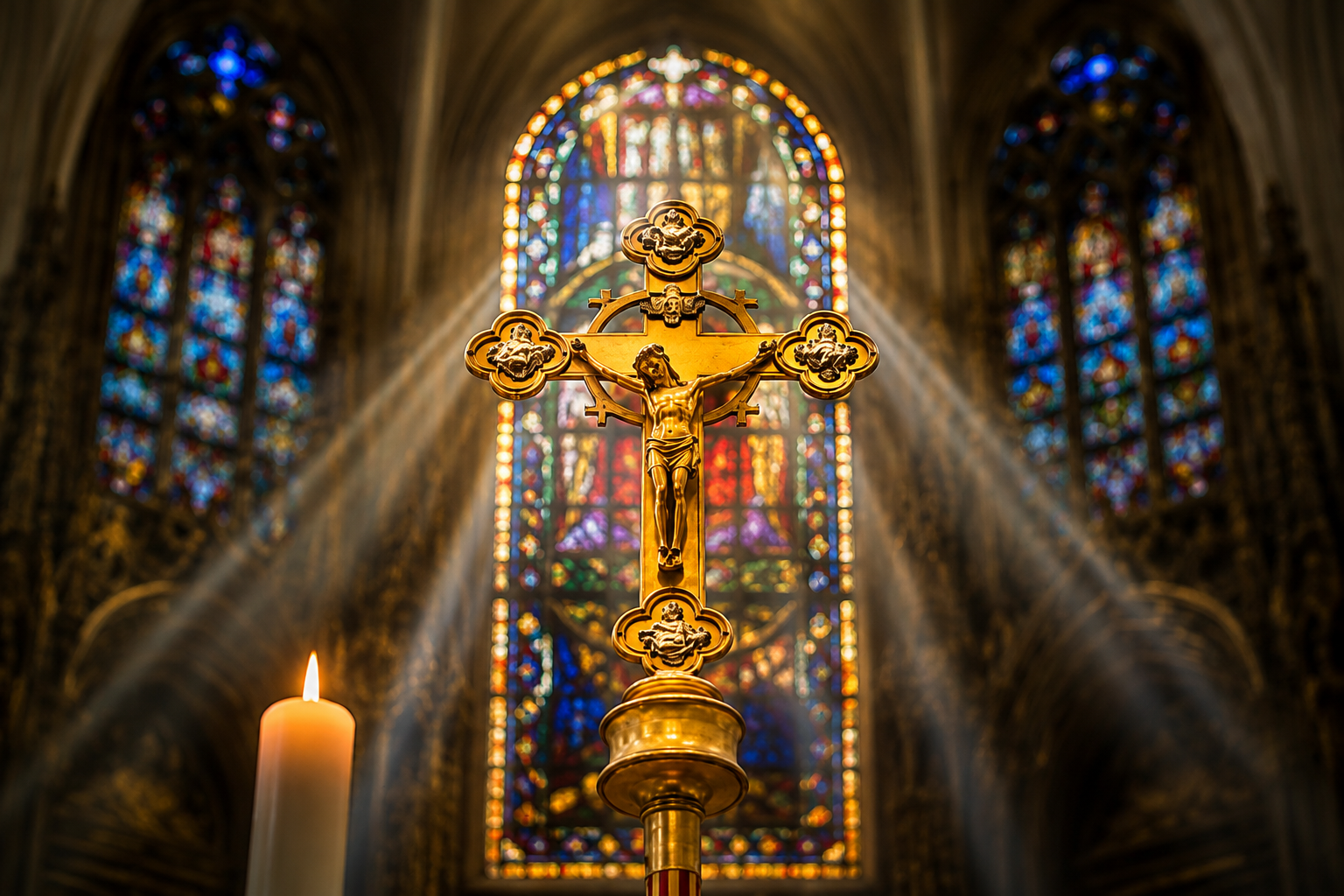
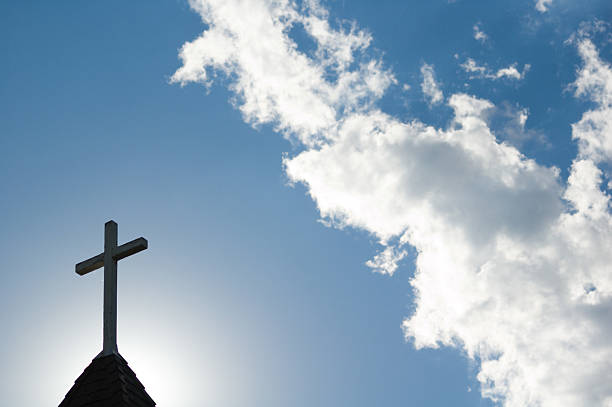
The prophecies of the Old Testament lead here; the preaching of the New goes out from here. The cross is not the sign of defeat but the measure of how far God has loved. To stop before the cross is to stop hiding one's weakness. From there prayer begins, and forgiveness.
✠ Begin with the sign of the crossHOW TO PRAY
- Sign of the crossIn the name of the Father, and of the Son, and of the Holy Spirit. Amen.
- Be stillSit for one minute without a word.
- ReadRead the verse of the day, once.
- SpeakPray in your own words, using the words you read.
- The Lord's PrayerClose with the words all Christians share.
- Sign of the crossEnd as you began.
Prayer
Prayer is not a technique but a relationship. On days when words fail, borrow the words the Church has kept for two thousand years: the Lord's Prayer, the Hail Mary, the Glory Be, the Psalms. Say them aloud and you will find you are not praying alone.
One in the morning, one at night. Kept up, prayer becomes the frame of a life.
- IFor whom will you pray today?
- IIWhat will you forgive today?
✠ Prayer wallPRAYER WALL
No published intentions yet.
✠ Send a prayer intentionINTENTION
For the sick, for those who have died, for anyone who is lost. You need not give a name. Everyone who visits this wall prays for what is written here.
What this place is, and is not
Stella di Betlemme
An independent, non-denominational Christian church
Stella di Betlemme is an independent, non-denominational Christian church community. It does not belong to any diocese, synod or denomination and does not claim any church's name. Teachings, liturgy, sacraments and traditions of the Catholic, Orthodox and Protestant churches are presented here as explanation and study only: this place explains them; it does not administer or represent them. The same care is given to Judaism and Islam, the other faiths of Abraham: described in their own terms, never claimed, never caricatured.
What you find here is explanation: the Bible, prayer, the church year, the creeds, the people of faith. The two illustrated works, KIBOJO and The IHS Project, are digital stories modelled on Scripture; they are windows, not the thing itself, and they stand well behind the articles.
Is this a church?
It is an independent, non-denominational church community online. It belongs to no diocese or denomination.
Do you offer sacraments, Mass or confession?
No. We explain what they are and what they mean in the historic churches. We do not administer them.
Are you Catholic, Orthodox or Protestant?
None of these by name. We explain the teachings and traditions of the historic churches faithfully, and remain independent.
Where should I begin reading the Bible?
A Gospel, Mark or Luke. In the Old Testament, the Psalms and Genesis. A little every day, at the same hour.
What is the difference between the Old and New Testament?
Promise and fulfilment. One God, one history of salvation.
What if I cannot find words to pray?
Borrow the Church's words: the Lord's Prayer, the Hail Mary, the Glory Be. Say them aloud.
What happens to a prayer intention I send?
It appears on the prayer wall without your name, and those who visit pray for it.
What are KIBOJO and The IHS Project?
Two illustrated digital stories modelled on Scripture. Windows onto the Bible, not the Bible itself.
What is Stella di Betlemme?
Stella di Betlemme is Italian for the Star of Bethlehem. In the Gospel of Matthew, wise men from the East follow a star until it stops over the place where the child lies. They were not priests and they were not from Israel; they were outsiders who paid attention and kept walking.
That is the picture behind this site. It is a place for people who are paying attention: readers who want the Bible explained plainly, without being asked to join anything first. Everything here points the same direction the star did.
The Old and New Testaments, explained book by book, word by word, person by person.
The prayers the Church has kept for two thousand years, and a wall where anyone can leave an intention.
Questions asked in the open, answered in the open. A forum, a community page, a way to join.
Who runs Stella di Betlemme?
IHS Bethlehem Church (IBC), an independent, non-denominational church. See the next section.
Is the site free?
Yes. Articles, prayers, the encyclopedia and the community are free. The store and membership are optional ways to support the work.
What language is it in?
English. Some sister sites are in Japanese.
Can I contribute?
Yes. Ask a question, send a prayer intention, post in the forum, or apply to join the team.
Do I have to be a member to read?
No. Nothing here is behind a membership wall except a few member extras.
What is IHS Bethlehem Church (IBC)?
IHS Bethlehem Church, IBC for short, is an independent, non-denominational church organized as a nonprofit in California. IHS is the ancient abbreviation of the name of Jesus in Greek; Bethlehem is where the story begins.
IBC does not belong to any diocese, synod or denomination, and it does not claim the name of any historic church. Its work is to explain: the Bible, the prayers, the church year, the creeds and the traditions of the historic churches, so that anyone can understand them. IBC does not administer sacraments and does not represent any other church. What it offers is plain teaching, prayer in common, and a place to belong.
Start with the articles and the verse of the day. No account needed.
Leave an intention on the prayer wall, or light a candle for someone.
Join the community, ask in the forum, or apply to join the team.
Is IBC a real church or just a website?
It is a church community that meets online, organized as a nonprofit. This site is its front door.
What does IHS stand for?
The first three letters of the name of Jesus in Greek. It has been used by Christians for centuries.
Is IBC affiliated with the Catholic Church, or any other?
No. IBC explains the teachings of the historic churches faithfully and remains independent of all of them.
Can I receive baptism, communion or confession here?
No. Those are explained here, not administered.
How is IBC funded?
By members, giving and the store. There are no ads sold to outsiders.
One God, and the children of Abraham
Before there was a church, a synagogue or a mosque, there was a man who left home on a promise. God said to Abram: go from your country to the land I will show you, and in you all the families of the earth will be blessed (Genesis 12). He went. He was not perfect; he lied about his wife, he laughed at God's timing, he sent Hagar away. But he trusted, and the Bible says that trust was counted to him as righteousness (Genesis 15:6).
Three great faiths look back to him. Jews as the father of Israel through Isaac. Muslims as Ibrahim, the friend of God, through Ishmael. Christians as the father of all who believe, because, as Paul writes, the promise came before the Law and before circumcision (Romans 4). Half of humanity calls him father. That is why this place, a Christian church, explains the other two faiths of Abraham with care and without pretending to speak for them.
What do the three faiths share?
One God who created the world, spoke to Abraham, and asks for faith, prayer, fasting, almsgiving, justice and mercy. Reverence for Moses, David and the prophets. The conviction that history is going somewhere and that God will judge it.
Where do Christians part from Jews and Muslims?
On Jesus. Christians confess that he is the Son of God, that he died for the sins of the world and rose from the dead, and that God is Father, Son and Holy Spirit. Judaism awaits the Messiah still; Islam honours Jesus as a prophet but not as God. These are real differences, and this site does not blur them.
Is this site Jewish or Muslim as well as Christian?
No. It is a Christian church, independent and non-denominational. It explains Judaism and Islam accurately because they are the family of Abraham and because the Bible cannot be understood without Israel. It does not teach them as its own faith and does not speak on their behalf.
Why speak of them at all?
Because Jesus was a Jew who prayed the Psalms, kept the Passover and taught from the Torah; because a fifth of the world prays to the God of Abraham as Muslims; and because a Christian who cannot say what Jews and Muslims actually believe has not understood his own faith well enough.
How does this place speak about other faiths?
The way it speaks about the historic churches: faithfully, in their own terms, without caricature, and without claiming them. Where we disagree, we say so plainly and without contempt.
The promise: a land, a people, a blessing for all nations (Genesis 12 to 22)
Two sons, two peoples; God hears Hagar in the desert and keeps his word to both (Genesis 16, 21)
The Law given to Israel: the Ten Words, the Sabbath, justice for the stranger (Exodus 19 to 24)
A king who sang; the prayers Jews, Christians and, in echo, Muslims still know (1 Samuel to 2 Samuel)
Isaiah, Jeremiah, Ezekiel: judgment and hope, a new covenant written on the heart (Jeremiah 31)
Born a Jew in Bethlehem; for Christians the Messiah and Son of God; for Muslims a prophet; for Jews a teacher of Israel
After the year 70 the two walk apart; the Christian Bible keeps the Hebrew Scriptures as its first and larger part
Seventh century Arabia: the Qur'an, and a community that names Abraham its father in faith
More than half the world prays to the God of Abraham; the conversation between his children is not finished
Hear, O Israel: the Lord our God, the Lord is one. You shall love the Lord your God with all your heart and with all your soul and with all your might.
— Deuteronomy 6:4-5
The Hebrew Scriptures: the Bible Jesus read
Why are the books in a different order?
The Jewish order ends with Chronicles and the hope of return; the Christian order ends with Malachi and the promise of the messenger who prepares the way. Both are deliberate. Neither is wrong.
What is the Talmud?
Not Scripture but the record of how the rabbis discussed and applied the Torah over centuries: the Mishnah and its commentary, the Gemara. Christians have nothing quite like it; the nearest thing is the writing of the Church Fathers.
Do Christians keep the Law of Moses?
The moral law, yes: the Ten Commandments, love of God and neighbour. The ceremonial law, sacrifices, food laws and circumcision, Christians hold to be fulfilled in Christ (Acts 15, Hebrews). Jews keep the whole Torah as the covenant God gave them. Both readings are ancient and serious.
Where does Islam stand on these books?
The Qur'an calls the Torah, the Psalms and the Gospel revelations from God, and Jews and Christians the People of the Book, while holding that the Qur'an completes and corrects them. Muslims read the Qur'an itself, in Arabic, as the direct word of God.
What are Hope Princess, KIBOJO and The IHS Project?
Are these stories part of the Bible?
No. They are original fiction modelled on the shape of the biblical story. The Bible is the text; these are windows onto it.
Who are they for?
Younger readers, families, and anyone who finds pictures easier than paragraphs.
Why keep them small on this site?
Because Scripture is the center here. The stories are helpful, but they are not the point.
Where do I find them?
KIBOJO at /kibojo/ and The IHS Project at /xmasfantasy/. Both link back to the articles here.
One faith, many rooms: the Christian families
The first thousand years: one Church, East and West, the creeds of Nicaea and Constantinople, the seven councils
Rome and Constantinople part. The Catholic Church looks to the Pope; the Orthodox Churches to their patriarchs and to the councils
Copts, Armenians, Ethiopians, Syriacs: churches that parted earlier, in 451, and kept faith through centuries of hardship
Luther, Zwingli, Calvin: Scripture alone, grace alone, faith alone. Lutheran and Reformed churches are born
Anglicans keep bishops, the Book of Common Prayer and a middle way between Catholic and Reformed
Believer's baptism, personal conversion, the warmed heart of John Wesley: churches of the ordinary reader
The twentieth century: the gifts of the Spirit, and the fastest-growing Christianity on earth
Communities that belong to no denomination and answer to Scripture and to their own conscience. This place is one of them
Which one is right?
Each will tell you. This place will not, because it is not a member of any of them. It explains what each teaches, in its own words, and leaves the reader free.
What do they all hold in common?
The Bible. The Apostles' and Nicene Creeds. The Trinity. Jesus Christ, truly God and truly man, crucified and risen. Baptism. The Lord's Prayer. The hope of the resurrection. That is a great deal; it is more than what divides them.
What is a non-denominational church?
A Christian community that does not belong to a denomination: no diocese, synod, convention or headquarters above it. It holds the common faith of the creeds, reads Scripture, prays, and governs itself. It is independent, not isolated: it learns from all the families and claims none.
Is non-denominational the same as Protestant?
Historically most non-denominational churches grew from the Protestant world, and many share its emphases. This place explains the Catholic and Orthodox traditions with the same care as the Protestant ones, and does not define itself against any of them.
Does IBC administer sacraments?
No. It explains baptism, the Eucharist, confession and the rest as the historic churches understand them. What IBC offers is teaching, common prayer, and a community.
There is one body and one Spirit, just as you were called to the one hope that belongs to your call, one Lord, one faith, one baptism, one God and Father of all.
— Ephesians 4:4-6
The church year
✠ Church calendar (month, feasts, events)CALENDAR
| Sun | Mon | Tue | Wed | Thu | Fri | Sat |
|---|---|---|---|---|---|---|
| 1 | 2 | 3 | 4 | 5 | ||
| 6 | 7 | 8 | 9 | 10 | 11 | 12 |
| 13Palm Sunday | 14 | 15 | 16 | 17Holy Thursday (the Lord's Supper) | 18Good Friday | 19Holy Saturday |
| 20Easter Sunday | 21 | 22 | 23 | 24 | 25 | 26 |
| 27 | 28 | 29 | 30 |
Feasts are calculated automatically from the Catholic calendar (individual churches may move or transfer some).
The creed
✠ The Apostles' CreedCREDO
✠ The Nicene CreedCREDO
The history of salvation
God makes the world and humankind, and calls it good (Genesis)
The covenant with Abraham: in your offspring all nations will be blessed
Passover and the Law: God leads his people out of slavery
David and Solomon: the temple and the prayer of the Psalms
Isaiah, Jeremiah: hope spoken in the midst of exile
The star of Bethlehem: the Word became flesh and dwelt among us
The centre of salvation: death does not have the last word
The birth of the Church: the apostles sent to the ends of the earth
The day you open the Scriptures
In the beginning was the Word, and the Word was with God, and the Word was God.
— John 1:1
How to read the Bible
Mark is the shortest. Luke has the Nativity. Read a chapter a day.
One Psalm each morning. They are prayers; read them as prayers.
Go back to the beginning and read the promise the Gospels fulfil.
Which translation should I use?
Any faithful modern translation you can read easily. The one you will actually open is the right one.
How much at a time?
A chapter, or less. Ten minutes at the same hour every day beats an hour once a week.
What if I do not understand a passage?
Keep going, and ask. The encyclopedia explains terms; the question page answers readers.
Should I read it in order, front to back?
Not at first. Gospel, Psalms, Genesis, then Acts. Leviticus and Numbers can wait.
Is the Old Testament still relevant?
Jesus quoted it constantly. The New Testament cannot be understood without it.
Mark 1 to 16: the shortest Gospel, one chapter a day, some days two
Psalms 1, 23, 51, 100, 121, 130, 139: learn to pray them
Luke 1 to 2, then 22 to 24: the birth and the Passion
Genesis 1 to 12: creation, the fall, the flood, the call of Abraham
Exodus 1 to 20: slavery, Passover, the sea, the Law
Isaiah 7, 9, 40, 53: the prophecies read at Christmas and Holy Week
John 1, 3, 6, 14 to 17: the Word, new birth, the bread, the last discourse
Acts 1 to 2: the Church is born, and you are part of the story
The Psalms: the prayer book of the Bible
The Lord is my shepherd; I shall not want.
— Psalm 23:1
The four Gospels: four portraits of one Lord
Why four Gospels and not one?
Four witnesses, four audiences, one Lord. Together they give a fuller picture than any one could.
Do they contradict each other?
They differ in order and emphasis, as honest witnesses do. The center, the cross and the empty tomb, is the same in all four.
Which should I read first?
Mark, for speed. Luke, for the Christmas story. John, when you want to go deep.
The Lord's Prayer, line by line
God is a father, and he is ours: we pray as a family, never alone
Before we ask for anything, we ask that God be honored
Not my plans first; his rule, here, now, through me
Heaven is where God is obeyed; we ask for earth to become that
Enough for today. Not a warehouse; a day at a time
The only petition with a condition attached, and the hardest
We know our weakness; we ask to be steered around it
The last word is rescue. Amen: so be it
Lord, teach us to pray.
— Luke 11:1
Words people ask about
Grace
A gift from God that is not earned and cannot be repaid. The whole Gospel in one word.
Covenant
A binding promise between God and his people. The Bible is the story of one covenant after another, ending in Christ.
Sin
Missing the mark: turning from God toward oneself. Not only bad deeds, but the direction of a heart.
Repentance
Turning around. Not feeling sorry, but changing direction.
Gospel
Good news: the announcement that Jesus has died and risen and that everything is different now.
Holy Spirit
God present and active in the world and in believers, the third person of the Trinity.
Liturgy
The public worship of the Church, ordered and shared, as opposed to private prayer.
Sacrament
In the historic churches, a visible sign through which God gives invisible grace. Explained here; not administered.
People of the Bible
A small rule of life
Sign of the cross. One verse. One minute of silence. Then the day.
The Lord's Prayer, wherever you are, quietly.
Look back over the day. Thank God for one thing. Ask forgiveness for one thing. Sleep.
✠ If you are new to all of thisWELCOME
You do not need to know anything to start. Read one verse. That is the whole first step, and it is enough for today.
Can I come if I am not a member?
Yes. Everyone is welcome. It is fine just to sit quietly and watch.
What should I wear?
Everyday clothes are fine.
Do I have to give money?
No. Give only if you wish, and only what you can.
Can I bring children?
Of course. If they cry, that is fine; everyone has been there.
Can I talk to someone afterward?
Yes. Speak to the clergy or a member. There is also an introduction course.
Scripture in pictures and sound
Community
✠ TestimoniesTESTIMONY
Add testimonies in Church Admin › Clergy & Groups.
Share a question, entrust a prayer, join the conversation.
Questions to carry for a week rather than answer at once. Remember them when you read, when you pray.
- IWhat does the word promise mean to me?
- IIWhat do I leave before the cross today?
- IIIWhose face do I see when I pray?
- IVIf I keep only one phrase from today, which?
After reading, meditating and praying, what remains is silence. Seek nothing; simply be there. Carry that silence with you when you close this page.
Site map
Latest partsLATEST CHAPTERS
Art Top → Study & Formation
Abraham, Father of Many Nations — What Jews, Christians and Muslims Share, and Where They Part
2026/09/05
Study & Formation
Abraham, Father of Many Nations — What Jews, Christians and Muslims Share, and Where They Part
2026/09/05
 Scripture
Hear, O Israel — The Shema, the Greatest Commandment, and the Prayer Jesus Prayed Every Day
2026/09/04
Scripture
Hear, O Israel — The Shema, the Greatest Commandment, and the Prayer Jesus Prayed Every Day
2026/09/04
 Parish Network
One Faith, Many Rooms — Catholic, Orthodox, Protestant and Independent: How the Christian Families D
2026/09/03
Parish Network
One Faith, Many Rooms — Catholic, Orthodox, Protestant and Independent: How the Christian Families D
2026/09/03
Reading RoomREAD FREE
All issues →Gallery PickupARTWORKS
All artworks →
Recent notes from the community.
The Ten Commandments and the Beatitudes
No other gods: the first word and the whole of the rest
No idols: nothing made by hands, and nothing made by the mind, in God's place
The Name: not to be used as a weapon, a joke or a decoration
The Sabbath: one day in seven that is not for sale
Father and mother: the first neighbour anyone has
No murder: and Jesus adds, no contempt, no anger nursed
No adultery: and Jesus adds, not even in the look
No stealing: including time, credit, and the wages of the poor
No false witness: the truth about your neighbour, even when a lie would help you
No coveting: the only commandment about a thought, because every other sin begins there
How do Jews and Christians number the commandments?
Differently. Jews count I am the Lord your God as the first word; Catholics and Lutherans join the first two prohibitions and split coveting into two; Orthodox and Reformed keep idols separate. The text is the same in every count.
Does Islam have the Ten Commandments?
Not as a numbered list, but the Qur'an repeats their substance: worship God alone, honour parents, do not kill, do not steal, do not commit adultery, do not lie. Muslims regard Moses as one of the greatest prophets.
Are the Beatitudes commands or promises?
Both. They describe what a person looks like when the Kingdom has taken hold of him, and promise what such a person will receive. They cannot be kept by effort alone; they are what grace produces.
You shall love the Lord your God with all your heart and with all your soul and with all your mind. This is the great and first commandment. And a second is like it: You shall love your neighbour as yourself.
— Matthew 22:37-39
Prayer in the family of Abraham
✠ A rule of hours anyone can keepHOW TO PRAY
- DawnThe sign of the cross. Psalm 63 or Psalm 5. One minute of silence.
- MiddayThe Lord's Prayer, slowly, wherever you are.
- AfternoonOne verse of the day, read twice.
- EveningThe Magnificat (Luke 1:46-55). Thanks for one thing.
- NightPsalm 4 or Psalm 91. Ask forgiveness for one thing. Sleep.
Do Jews, Christians and Muslims pray to the same God?
All three intend the God of Abraham, the one creator and judge. Christians confess that God as Father, Son and Holy Spirit, which Jews and Muslims do not. The intention is shared; the understanding differs. Honest people on all sides say both things.
May a Christian use Jewish prayers?
Christians already do: the Psalms, the Shema quoted by Jesus, the blessings behind the Eucharistic prayer. The Lord's Prayer itself is Jewish in every phrase.
What about the Qur'an?
A Christian may read it to understand a neighbour, as this place does, without praying it as Scripture. Reading is not confessing.
Fasting, giving, pilgrimage
Jews fast on Yom Kippur; Muslims for the month of Ramadan; Christians in Lent and, in the East, on Wednesdays and Fridays. Hunger reminds the body who is in charge of it.
Tzedakah in Judaism, zakat in Islam, the tithe and almsgiving in Christianity. In every case the poor have a claim, not a request, on what we own.
Jerusalem for all three; Mecca for Muslims; Rome, Santiago, Canterbury, the Holy Land for Christians. To walk somewhere is to admit you are not yet home.
Is fasting required of Christians?
The historic churches ask for it in Lent and on certain days; the details vary. No church requires it of the sick, the very young or the old. Here it is explained, not imposed.
What is a tithe?
A tenth of one's income given to God's work and the poor, from the Law of Moses (Leviticus 27). Some churches teach it as a duty, others as a guide. Giving on this site is entirely free and nothing is unlocked by it.
Is there a pilgrimage here?
Only the one the star made: from wherever you are to the child in Bethlehem. Begin with one verse.
A calendar of holy days
Four Sundays before Christmas: waiting, the prophets, John the Baptist, Mary
December 25 and January 6: the birth at Bethlehem and the wise men who followed the star
The Jordan; the Father's voice; the beginning of the public ministry
Forty days from Ash Wednesday: fasting, prayer, almsgiving, the wilderness
Palm Sunday, Maundy Thursday, Good Friday, Holy Saturday: the Passion kept day by day
The empty tomb; fifty days of the risen Lord; the centre of the whole year
Christ returns to the Father; the Spirit comes; the Church is sent
The long green season: the teaching of Jesus, Sunday by Sunday
November 1 and 2: the communion of saints and the faithful departed
The last Sunday: the year ends where it will end
✠ Church calendar (month, feasts, events)CALENDAR
| Sun | Mon | Tue | Wed | Thu | Fri | Sat |
|---|---|---|---|---|---|---|
| 1 | 2 | 3 | 4 | 5 | ||
| 6 | 7 | 8 | 9 | 10 | 11 | 12 |
| 13Palm Sunday | 14 | 15 | 16 | 17Holy Thursday (the Lord's Supper) | 18Good Friday | 19Holy Saturday |
| 20Easter Sunday | 21 | 22 | 23 | 24 | 25 | 26 |
| 27 | 28 | 29 | 30 |
Feasts are calculated automatically from the Catholic calendar (individual churches may move or transfer some).
Why does Easter move?
Because it is fixed to Passover, which follows the moon: the first Sunday after the first full moon after the spring equinox. Christmas is fixed to the sun. The two calendars meet in the person of Jesus.
Why do East and West differ?
The West adopted the Gregorian calendar in 1582; most Orthodox churches kept the Julian for Easter. Every few years the dates coincide, and there is talk of making that permanent.
Does this site keep feasts?
It marks them, explains them, and counts down to the next one. It does not hold services; it is a place to read and pray.
Three windows onto the same light
The text itself: the Old and New Testaments, explained word by word, person by person, feast by feast.
Icons, altarpieces, chant and hymns: the Bible as the eye and the ear have received it for two thousand years.
Hope Princess, KIBOJO and The IHS Project: original fiction shaped like the biblical story, kept deliberately small on this site.
One verse today. One prayer tonight. That is the whole first step.
Arise, shine, for your light has come, and the glory of the Lord has risen upon you.
— Isaiah 60:1